In a world where robots might soon be serving your coffee or writing your next blog post, understanding artificial intelligence has never been more crucial. Whether you’re a tech enthusiast or just trying to keep up with your AI-savvy friends, diving into the right books can turn you from a curious novice into a knowledgeable insider.
Overview of Artificial Intelligence Literature
Artificial intelligence literature encompasses a wide range of genres and topics. Academic texts provide foundational knowledge, while popular science books appeal to general readers. Key figures in AI, such as Stuart Russell and Peter Norvig, have authored definitive works that lay out principles and theories.
Numerous genres exist within AI literature. Technical textbooks focus on algorithms and programming techniques. These resources benefit students and professionals alike. Additionally, introductory books simplify complex concepts for those new to the field.
It’s crucial to consider the impact of fiction on the perception of AI. Novels and stories often explore ethical dilemmas and future implications. Works like Isaac Asimov’s “I, Robot” and Phil K. Dick’s “Do Androids Dream of Electric Sheep?” stimulate discussions about morality and technology’s role in society.
Notable titles also reflect contemporary advancements. For instance, “Superintelligence” by Nick Bostrom delves into potential risks of advanced AI. Angela Saini’s “Inferior” tackles biases in AI, signifying that literature often critiques and guides industry practices.
A diverse selection of articles and journals enhances understanding as well. These sources offer insights into cutting-edge research and current trends in AI. Publications like the Journal of Artificial Intelligence Research provide peer-reviewed content vital for staying informed.
Books on AI play a transformative role in shaping perceptions and knowledge. By reading widely, individuals can better understand technology’s implications while fostering critical thinking about its future.
Must-Read Books on Artificial Intelligence
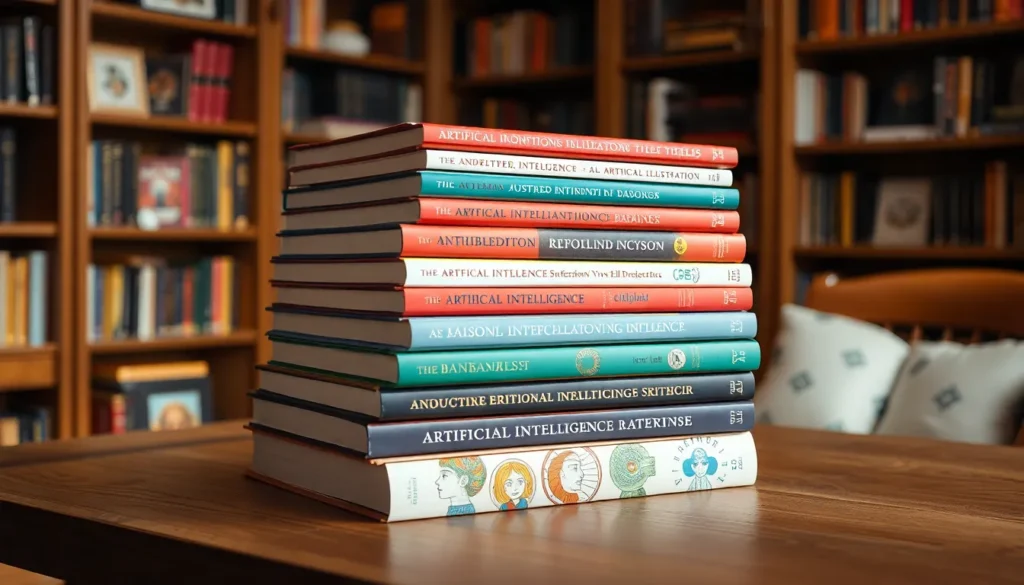
Books on artificial intelligence provide essential insights into various aspects of the field. Readers gain knowledge through foundational texts and contemporary works.
Foundational Texts
Foundational texts lay the groundwork for understanding AI’s core principles. Stuart Russell and Peter Norvig’s “Artificial Intelligence: A Modern Approach” serves as a comprehensive guide, covering algorithms and problem-solving techniques. John McCarthy’s work introduced key concepts, making AI accessible for academic study. “Pattern Recognition and Machine Learning” by Christopher Bishop discusses statistical approaches, offering a solid framework for machine learning applications. “Human Compatible” by Stuart Russell explores ethical implications and challenges. Each text contributes to a robust understanding of AI’s fundamentals.
Contemporary Works
Contemporary works address current advancements and debates in AI. Nick Bostrom’s “Superintelligence” examines the risks associated with advanced AI systems, focusing on their potential impact on humanity. Angela Saini’s “Inferior” critiques biases in AI and other scientific fields, highlighting the intersection of technology and social issues. “Weapons of Math Destruction” by Cathy O’Neil discusses the dangers of algorithm-driven decisions in society. Additionally, “Life 3.0” by Max Tegmark explores future scenarios shaped by AI developments. These books engage readers with pressing questions about the technology’s future.
Books on AI Ethics and Implications
Ethics in artificial intelligence is critical as technology continues to advance. Understanding the implications of AI requires engaging with important literature on the subject.
Key Authors and Their Perspectives
Stuart Russell and Peter Norvig, renowned figures in AI, emphasize the importance of aligning AI systems with human values. Nick Bostrom explores existential risks posed by superintelligent AI, highlighting the significance of ethical foresight. Shannon Vallor focuses on the ethical dimensions of emerging technologies, advocating for responsible AI development. These authors offer insights into both theoretical frameworks and practical considerations, encouraging thoughtful discussions on the ethical implications of technology.
Topics Covered
Literature in AI ethics addresses various topics. Key issues include the alignment of AI objectives with human interests and the implications of autonomous decision-making. Important discussions revolve around bias in algorithms, data privacy concerns, and transparency in AI systems. Authors also examine the societal impacts of AI, especially in labor markets and decision-making processes. Engaging with these topics fosters deeper understanding and encourages critical evaluation of AI’s role in society.
Future Trends in Artificial Intelligence Literature
Emerging trends in artificial intelligence (AI) literature reflect advancements in technology and societal concerns. Literature increasingly addresses the impact of AI on daily life, with a focus on accessibility and clarity for broader audiences. Books that explore AI ethics are gaining prominence, emphasizing the importance of aligning technology with human values.
New releases often include discussions on the implications of AI in various fields, such as healthcare, finance, and education. Titles like “The AI Revolution in Medicine” by Eric Topol highlight how AI transforms medical practices and patient care. Studies also delve into AI’s influence on job markets, exploring potential job displacement and new career opportunities.
The role of interdisciplinary approaches in AI literature is more significant than ever. Writers incorporate insights from sociology, psychology, and philosophy to provide a holistic view of AI’s societal effects. Works like “Human Compatible” by Stuart Russell offer perspectives on ensuring AI systems align with human priorities.
In addition, fiction continues to play a vital role in shaping perceptions of AI. Recent novels like “Klara and the Sun” by Kazuo Ishiguro blend storytelling with explorations of consciousness and ethics, encouraging readers to think critically about the future of technology. Non-fiction titles also highlight the urgency of addressing ethical dilemmas posed by AI, with authors like Nick Bostrom leading discussions on existential risks.
As AI technology evolves, so too will the literature. New authors are emerging with fresh perspectives, addressing contemporary challenges and opportunities in the AI landscape. A diverse reading list, encompassing foundational texts and contemporary critiques, remains essential for staying informed on the rapidly changing field of AI.
Exploring the vast landscape of books on artificial intelligence equips readers with the knowledge needed to navigate today’s technology-driven world. From foundational texts to contemporary critiques the literature offers invaluable insights into AI’s principles and ethical implications.
As the field evolves so will the narratives surrounding AI, making it crucial for individuals to stay informed through diverse reading. Engaging with both scholarly and popular works fosters a deeper understanding of how AI impacts society and encourages thoughtful dialogue about its future. Embracing this literary journey can empower readers to critically assess the role of technology in their lives and the world at large.